
Worldwide, players are fascinated with Mahjong due to its combination of strategy, luck, and sociability. The ancient Chinese game of skill and chance originated in China as a tile based game and has become widely recognized as a great pastime. Like Rummy the object of Mahjong kostenlos is to use the tiles drawn and discarded to create certain winning combinations but with a complication: the tiles are inscribed with ancient, intricate Chinese symbols, and have a far greater importance and significance in the minds of the Chinese people than this.
Mahjong is not only highly useful as a brain tester but contributes to the strengthening of the social cement, thereby furthering the cause of humanitarianism. This accounts for the popularity of the game. It is played everywhere – in parlors, clubs and tournaments in all countries and among all classes.
Origin and History
Mahjong has its roots in the game that is said to have originated in the latter part of the nineteenth century in China as a parlor game introduced among the higher classes of society during the reign of the Ching dynasty. It is said that Confucius invented it, but historians state that its first appearance was about 1850 in Ningpo, by the combination of different features of games of cards and Dominoes.
By the early part of the twentieth century it was sent into the Western world by missionaries and salesmen, which forced the introduction of this up-to-date past-time in the 1920s when a tremendous rage for it was found to exist. Standard rules of the game were built up and they were made in sets for general distribution.
The evolution of the game has kept pace with the social conditions of the empire of China. It has gone from an imperial pastime to a great competitive sport. The rules of the game were perfected by the intellectuals of the Republic, while the Communists, after 1949, forbidding the game on the mainland, drove it to a wide popularity abroad. With its international federations the game lives on as a sign of determination and of the will of a great people.
The Basic Rules and Gameplay
Usually four persons will take part in a game of Mahjong, each starting with 13 tiles taken from a set of 144, which comprise the several suits – bamboos, circles, characters and the honors, which are the winds and dragons. The goal is to complete a hand of four sets (melds) and a pair by drawing from a wall of tiles or taking discarded pieces from opponents. Players alternate turns, clockwise, discarding one tile after drawing, and calling “pung,” “kong,” or “chow” in order to make melds openly.
Winning is accomplished when a player completes his hand and calls, “mah-jong,” when he has completed his hand, and many times is scored then for the difficulty of the hand and the abolition of the tile on which the hand is completed. The dealer rotates from hand to hand, and there are many hands to every game, until one player has scored a certain number of points, known as the game point. This rhythmical procession requires the players’ respective attention, for sometimes a single discard may change the balance of the entire game.
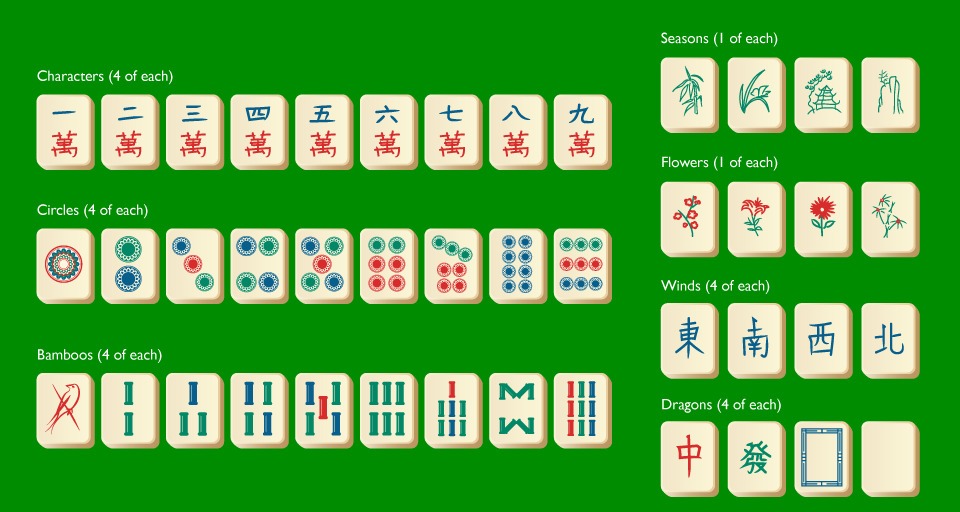
Scoring systems differ, but the usual rules consist of granting points for special hands such as all pongs, pure sequences, etc. There is much exercise and balance of aggressiveness and defensive measures. The players seek not to discard tiles that are needed by their rivals, and for this reason, for this reason, the game is often said to demand powers of acumen, as well as the playing of psychological tactics.
Types of Mah-Jong
The Chinese Classical Mah-Jong is the oldest and most patriotic form of Mah-Jong, and it consists of 144 tiles, with very complicated scoring systems, and employing flowers and seasons as bonuses. In this system, the players consider fan figures in calculation of the value of a hand, and indulge in risks, such as robbing a kong. This system of scoring is particularly in vogue in the territory of Hong-Kong and that of Tai-wan, where family reunions are often used as an excuse for lengthy sessions of Mah-Jong.
American Mah-Jong was an adaptation of several ancient systems in use in the early twenties, and is a set of rules marked by commingling the number of tiles to be used and adroitness in dispensing with the needs of the tiles, as with the use of the joker tile, and a unique card arrangement called the “charlie.”
National Mah Jongg League cards for their member set are put out annually. It entails the possibility of certain hands being made illegal and therefore rendering all players with the certain set to play, and prohibits the others from playing. It has proven appealing to Western players, because of its rhythmical plans and the advantage it has for many clubs and their clientele.
Japanese Riichi Mahjong introduces betting elements with each player declaring “riichi” for bonuses for a cash-out feature increasing the drama. Yaku requirements define the hand to win and dora tiles add chance factors to this rapidly-growing arcade and online variation which has led to its growth in acceptance in anime shows and other esports categories.
Other regional sub-variations exist having to do with Vietnamese or British Mahjong affecting counts of tiles played with changes in both play and scoring. Players pick their variety depending on their own preferences, guaranteeing endless playability. All variations retain the original core mechanics endowed with many regional variations.
Strategies and Tips for Beginners
Beginners should start with the different tile suits and honor suits to sort their hands to melds, then get pretty fast with it. Watching other players discards will give an inkling as to gambling theories of generalization involving enabling safe defensive plays, such as fold safes. With time a player will master the various ways of baiting calls to the table by discarding good calls that are appealing to get players deceived.
A good strategy involves getting a good balance between speed and caution in observing the hands. Caution gets you nowhere since it slows the hands, while a too speedy hand enables being exposed out in the cold. Keeping track of the tile involves counting means of estimating what the call per tile is for what is left for drawing for keeping alive the essential tiles. Further, kong calls require a review of tiles called to elongate tile plays necessitating risk assessment.
For their improvement several of the casual games can be played to develop intuition without much pressure. A broad study of the yaku or made combos approximately play in them, with consistent guaranteed priorities. Finally it is said that patience is a virtue, and certainly psychological bonanzas go a long way in helping your game at the table grow, as the game rewards those who have flexibility.
There are low-stakes simulators such as these online for impromptu practice for apportioning discards to get good knowledge from practice. Caesars tended to never like discarding winds for reasons that represent a totted value since they score so at all times. By being more watchful of the good calls of possible scoring the novice can be made to convert into the champions.